

Incarceration, Execution, and the Architecture of Colonial Violence
by Ayda Issa on behalf of TPAN

The mass incarceration of Palestinians, alongside the introduction of the so-called “new death penalty” law approved by Israel’s parliament are not neutral legal processes, but tools of colonial violence designed to control, fragment, and suppress an occupied population.
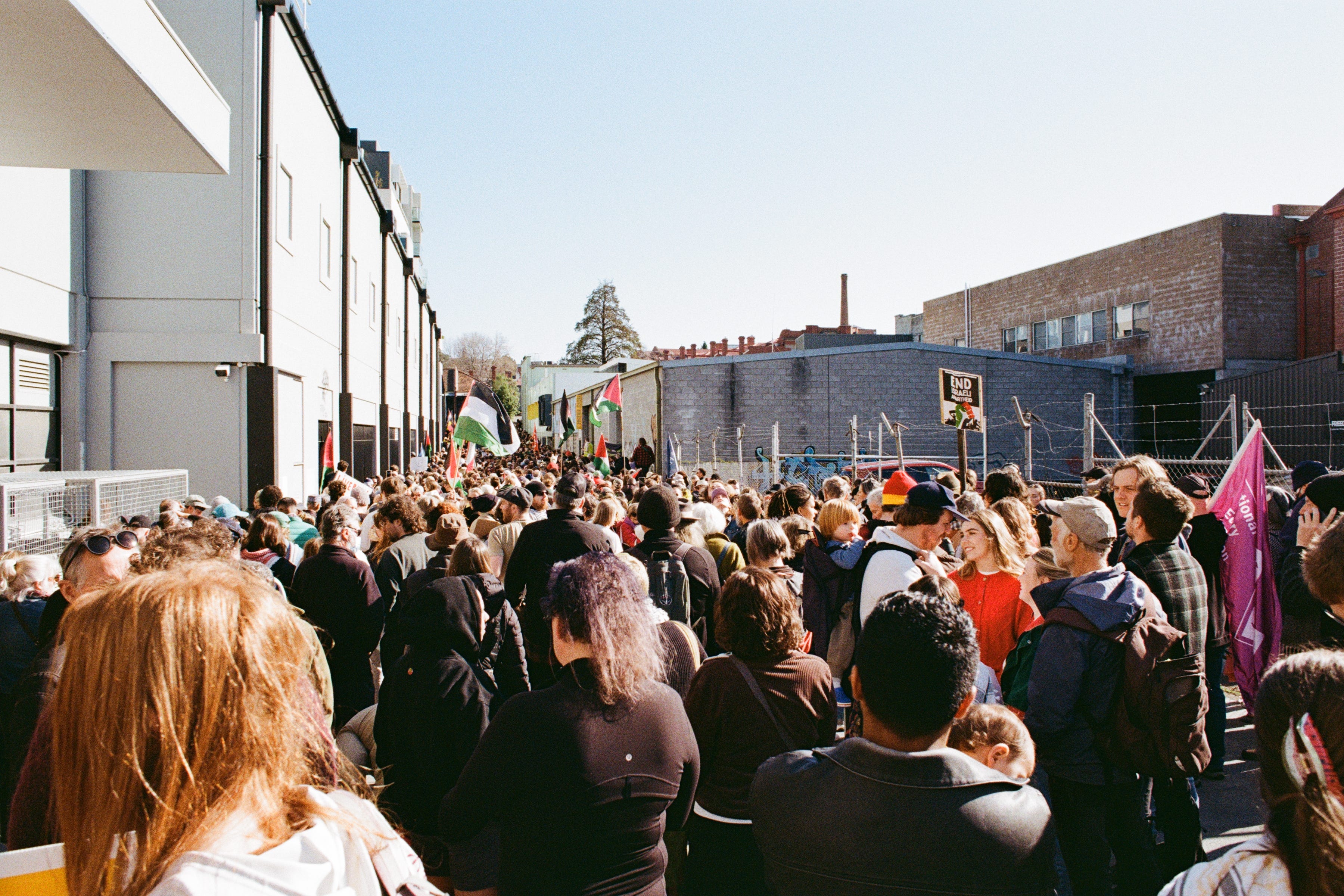
Photography by Kristy Alger
From the earliest days of the zionist Israeli occupation, imprisonment has played a central role in governing Palestinian life. Mahmoud Bakr Hijazi, the first Palestinian political prisoner under the zionist occupation, was sentenced to death before being released decades later in a prisoner exchange. His case is not an exception but emblematic of a system that continues to shape Palestinian life to this day.
Each year on April 17, Palestinians mark Prisoners’ Day, established in 1974, to honour the thousands of Palestinian men, women, and children who have been incarcerated. In doing so, we must also be precise in how we speak about them.
Language is not neutral. It shapes how Palestinians’ political reality is understood.
The terms political prisoner and political detainee are not rhetorical choices but deliberate. These terms originate from the Palestinian prisoner movement, developed alongside the Palestine Liberation Organisation and shaped through exchange with other revolutionary struggles. The concept of the political prisoner travelled across anti-colonial contexts—from Angola to Vietnam and Ireland—situating Palestinian incarceration within a broader anti-colonial struggle. While “detainee” often refers to those held without charge under administrative detention, and “prisoner” to those “formally” charged, both require the qualifier political because Palestinian imprisonment does not resemble ordinary legal detention.
It is not governed by a transparent legal process. It is not bound by equal application of law. It is not, in any meaningful sense, justice.
To describe Palestinians as “prisoners” without context risks normalising a system that is anything but normal.
Equally important is what we reject.
The term hostage is a highly emotive and politically loaded word that was rapidly and consistently deployed across multiple mainstream media outlets to describe Israeli citizens taken on October 7, often without broader context. In doing so, the reality of prolonged occupation, displacement, and systematic inequality that existed for Palestinians prior to the events of October 7 were minimised or completely omitted from public discourse.
By contrast, mainstream media rarely applies the same term to Palestinians even when they are often detained without charge, held indefinitely, and denied legal recourse.
In response to the double standard, the term hostage has been adopted to describe detained Palestinians in an attempt to create moral symmetry with Israelis. However, its use obscures the fundamental asymmetry of the situation and flattens the reality it seeks to critique.
There is no equivalence between occupier and occupied.
Humanitarian discourse has long conditioned solidarity to be contingent on Palestinian victimhood. In this framing, hostage reduces Palestinians to passive victims and strips their struggle of political meaning. This expectation of passivity leaves no room for political prisoners and their families whose experiences are too complex, too politically charged or too militant to fit within it.
The word hostage also suggests exchangeability, when in reality incarceration of Palestinians functions not as leverage, but as a mechanism of domination.
A hostage waits to be rescued. Palestinians do not have that expectation.
Global institutions that are meant to guarantee protection and accountability have repeatedly failed to act, and international law has not been upheld in any consistent or meaningful way.
There is no reliable framework of rescue or enforcement that Palestinians can depend on.
Survival, therefore, is not grounded in external intervention but in persistence. Survival is not passive, it is political. It is rooted in resistance, organisation, and collective endurance.
This is precisely why language matters. It is also why it is weaponised.
Orientalist narratives continue to construct Palestinians through a racialised lens: as terrorists, inherently violent, and threats to be contained. Palestinian men are depicted as barbaric and extremist; Palestinian women are rendered as passive victims of patriarchy, culture, and religion. These representations do not merely distort reality, they justify repression.
They obscure the fact that many Palestinian political prisoners are also writers, artists, scholars, and political thinkers.
Mohammed Al Rakoui, in an act of defiance against the dull, restricted world of prison, produced art in bright, vivid colours and through art he reclaimed a sense of freedom.
Walid Daqqa transformed prison into a site of intellectual and cultural production, writing extensively until his death after decades of incarceration marked by medical neglect.
Nasser Abu Srour authored a memoir from within prison walls, turning confinement into testimony and narrative.
Incarceration was intended to end their political life, but instead it became another site where it was actively produced and contested. Even under extreme constraint, imprisonment can become a space for political thought, memory, and cultural expression.
Ahed Tamimi, detained at 17, emerged as a global symbol of resistance as a teenager, her image circulated widely as shorthand for youth defiance under occupation.
Khalida Jarrar, a lawmaker, feminist, and long-standing political figure, has been repeatedly imprisoned, illustrating how formal political participation itself becomes grounds for incarceration.
Taken together, these lives are not isolated or exceptional cases. They are part of a broader collective experience in which imprisonment and resistance are deeply intertwined. Rather than suppressing political life, incarceration has often become one of its central conditions of production.
Even within prison, resistance persists.
To understand that experience, incarceration must be approached as a structural system.
Palestinians live under military law, not civilian law. They are tried in military courts with conviction rates approaching totality, often based on secret evidence or coerced confessions. Thousands are currently detained in administrative detention which allows for indefinite imprisonment without charge or trial. While thousands more are serving out sentences in Israeli prisons after being subjected to unlawful detention and sham legal proceedings.
Palestinians experience torture and abuse in custody—physical, sexual, psychological, and medical—it is both widespread and systematic. Human rights organisations have described this as a form of “slow killing,” evidenced by recurring deaths in custody.
Now, with the expansion of the death penalty, this violence is no longer only implicit, it is formalised.
At a time when much of the world has moved to abolish capital punishment, Israel is entrenching it. This law does not operate equally. It is racialised in both its application and intent. It removes one of the last remaining legal barriers that could protect Palestinian prisoners from execution.
This is not justice. It is state violence, codified.
The targeting of children further exposes the logic of this system. Hundreds of Palestinian children are detained each year, many without charge. They are arrested in night raids, blindfolded, restrained, physically assaulted, strip searched, interrogated without legal counsel, and coerced into signing confessions presented to them in a language they cannot understand.
Nadera Shalhoub-Kevorkian describes this process as “unchilding”, which is defined as the systematic stripping away of childhood itself. Palestinian children are not treated as children, but as threats to be managed. Their anger and frustration at an occupation they did not choose are pathologised and their existence is securitised.
Unchilding begins long before imprisonment, through surveillance, restriction, and militarised control of daily life, gradually stripping them of the protections and assumptions that define childhood elsewhere.
It is a system preparing them to be subjected to structural violence and abuse.
The targeting of children is not unique to Israel. In Australia, First Nations children are disproportionately incarcerated, drawn into the justice system at younger ages and at vastly higher rates than their non-Indigenous counterparts. In both contexts, incarceration operates as a tool of control that extends beyond the individual child.
Children are targeted not necessarily for what they have done, but because of what they represent: the continuity, survival, and future of their communities. By intervening in childhood, these systems disrupt intergenerational transmission, fracture social bonds, and weaken collective political and cultural life. In this sense, the incarceration of children functions as a form of collective erasure.
Incarceration also functions to fragment political life.
You may be aware of campaigns for the release of Palestinian political prisoner Marwan Barghouti. Calls for his freedom are not simply appeals for individual release; they expose how incarceration is used strategically to reshape the political field itself. Removal of political figures from public life, like Barghouti, through sustained imprisonment produces leadership vacuums and disrupts the formation of cohesive political direction.
In this sense, the “Free Barghouti” campaigns are also a demand to recognise how carceral systems operate as instruments of political engineering under conditions of occupation. His continued imprisonment represents a broader logic in which Israel’s incarceration of key political figures is central to maintaining a fragmented Palestinian polity and obstructing Palestinian political self-determination.
Figures like Barghouti, who are widely respected across political factions, remain imprisoned by Israel by design.
International law, at least in principle, prohibits many of these practices. The Fourth Geneva Convention forbids torture, coercion, unlawful transfer, and denial of fair trial. It recognises the rights of those living under occupation.
But law without enforcement becomes theatre.
What remains is the reality on the ground: a system in which incarceration and execution are embedded within a broader architecture of domination.
These are not isolated policies. They are part of a coherent strategy:
To suppress political mobilisation.
To fragment society.
To enforce racialised control.
To normalise violence as governance.
Palestinian incarceration by Israel cannot be viewed as a series of individual isolated cases.
It must be recognized as a system that operates at a scale, with consistency and intent, that shapes both the individual lives and collective condition of the Palestinian people.
And systems, unlike narratives, cannot be neutral.